Friday, June 15, 2007

LAB- CELL MODEL- PARTS


PARTS OF THE CELL


My cell model is composed inside of a styro ball, the outer portion signifying the cell membrane. The right picture is my completed version. Below I will show different pictures relating to the functions and different parts of the cell as I pieced it together. A cell is a master piece; the tiny living cells reproduce numerous times, little messengers scurry around to process information to make replication of a new cell possible. I will also explain the process of mitosis and DNA replication.


The pink yarn represents the Goligi Apparatus: The structure is like an operation stand, it obeserves different objects received such as proteins and lipids, and adjusts/modifys them.


The pinks beads and the green styro are formed to make a mitochondria: This structure is like an Energizer Bunny. It coverts the energy of glucose into a chemical energy of ATP. It is also known for its function of cellular respiration, since the mitochondria drains up all the oxygen and is forced to release carbon dioxide.

The staples make up the endoplasmic reticulum and the beads represent ribosomes (with beads is the rough/without is smooth). The function of ER is to help transport molecules to different parts of the cell: the neighboring golgi apparatus. The rough ER synthesize proteins and form a vesicle and the smooth ER, synthesize lipids.
Pink yarn/ball make up the nucleus, an important part of a cell, which stores the genetic information. The microscopic parts inside of the nucleus are important for functioning and transporting. Later, I will discuss the process of DNA replication which involves the protein and messengers.


The black pipe cleaner represents the cilia. Which is like a watch dog for the cell, it has a sweeping motion which helps protect foreign particles from entering the cell. The green beads are vesicles and lysosomes. Vesicles travel around the cell, and drop off contents they collected from the golgi apparatus. The lysosomes are scattered around the cell, but are abundunt in WBC, where they eat(engulf) disease micro-molecules.


Wednesday, June 13, 2007


LAB TWO: Genetics


Dragon/Punnett Square

Below are pictures of the two lab projects pertaining to genetics. These lab projects toured through different examples of the process of genetics. The little dragon went through a process of changes in his chromosome types, but with skill became genetically identical to his father. The little fly was brought through a whirlwind, while piecing together the Punnett Square. Both of the labs descriptively showed the inheritance of genes. While describing each project, I will give a brief description of several genetic terminology. To start off, the genotype is the gene of the specific organism/individual. While the phenotype is the physical appearance. An allele is when the gene is on the same position with the same trait on a chromosome. Typically an allele is described using a letter. Gene inheritance is a significant piece of information, because it obviously is passed on from generation to become who we are. Parents make wonderful offspring's. Learning about genetics is important, especially when it comes to family history of diseases. Parents can be carriers for these disorders, the popular way for checking is by using a Family Pedigree chart. This gives a clear example if the disease will be passed on to the offspring.
Dragons. This lab showed the process of changing the genotypes (genes of the dragon) and phenotype(the physical appearance: sweeping tail, flapping wings, horns, feet). Genes are known as traits inherited from generation to generation. Labeled to the right of the screen were the different chromosomes of the dragon, the purpose was to change the Allele's (the letters/gene with the same position and trait on a chromosome). Dominant traits are classified in capital letter while recessive traits are in lowercase letters. There are three different possible ways to describe the fertilization. 1. Homozygous dominant genotype. The dragon has the same tail alleles: TT. 2. Homozygous recessive genotype. The dragon had several examples of the same recessive allele: ss(scales), ff(fire) aa(color) pp(plates) ww(wings). 3. Heterozygous genotype. The dragon had two alleles: Hh(hair) Bb (color). Many of the genotypes are that of a homozygous recessive gene.

Flies. The "father of modern genetics" is given to a scientist known as Gregor Johann Mendel, who researched mainly plants. Many genetic researchers find the Fruit fly to be a popular modular organism, as shown to the right (wiki). During the lab portion of the Punnett Square, it shows how this process predicts the offspring of genes. The mother and father were both heterozygous (Ll). The offspring resulted in a dominant homozygous trait(LL long-winged) and a recessive trait (ll short-winged). The other two were that of the parents: heterozygous(Ll long-winged). This project proves to show how traits pass on from each generation.

Terminology
Genotype: Represents the genes carried by the individual/organism. Examples (ff fire) (ww wings) (LL long wing) (ll short wing)
Phenotype: The physical appearance of the individual/organism. Examples from the dragon: horns, fire, legs, tail, and wings. The fly phenotypes were: long/short wing

Allele: Is a form of a gene. It represents one or more DNA sequences( gene positioned the same on a chromosome producing the same phenotype trait). Classified as a dominant or recessive allele.

Cross: Two different crosses were discussed in this chapter: one-trait and two-trait. An example of the One-trait is the fly punnett square. Finding the chances of the offspring having a long-wing or short-wing. Parents often get curious what color eyes/how tall their child will be. The Two-Traitis the relation of meiosis formed by gametes. It is a combination of genes. Examples in the book were the phenotypes: widows peak and short fingers. This is done using a Dihybrid cross- to find the possibilities of genotype and phenotype.
The dominant and recessive traits are discussed under both of the lab pictures.

Experimenting with these labs, marked the interest in the process of inheriting different genes. The dragon turned out identical to its father, after changing the characteristic traits of the little dragon to match the genes of the father. The fly matched well, with the simple cross section between two heterozygous parents. Passed on from generation, offspring's typically look like their parents/grandparents/siblings, some have a dominant trait while others inherit a recessive trait. Genetic inheritance can be a fun way to experiment, but also can be serious when it comes to the possibility of inheriting a family disease.

Works Cited:
Fly lab
quote/picture of fly
Dragon lab

picture is of my sister and her son: genetic generation :)


Tuesday, June 12, 2007

Compendium # 2- Genetics

Topics


1. Mitosis-cell division
2. DNA/chromosomes

3. DNA Technology

4. Cancer

5. Roles of Genes

Once again our internal lives are constantly changing, reproducing and full of detailed processes. During this section, I have found DNA to be quite interesting. It seems as though DNA is similar to a green light, if it's green, cells are going to keep going through their required processes to full fill the duties. DNA is very useful source of information. It helps detect diseases, helps to improve the agriculture, research family inheritance, and used to investigate criminals. There are so many interesting concepts in the Genetic section, I will discuss the main topics mentioned above.

Each little cell in our body goes through, MITOSIS, the process of nuclei division. More important it is an identical process that copies the genetic information. During the process of division, two identical daughter cells are formed, having the same number and type of chromosomes. During the duplication stage, the two exact chromosomes, are known as sister chromatids. (which are connected by a centromere(a little ball connecting the two)) After they split from the centromere, the sister chromatids become chromosomes(diploid). These chromosomes are distributed equally and are eventually genetically identical. Mitosis is a constant function within the body. There are four stages that are important in Mitosis. Prophase is when the chromosomes are noticeable: like worms bunched together. Centromeres have duplicated and are awake pushing their bodies towards different ends of the cell(poles). They develop spindle fibers(resemble little tails) to help move the chromosomes(worms) throughout the nucleus. During metaphase, the chromosomes are lined up (like little soldiers) at the center of the cell where the spindle fibers have attached to the sister chromatids at each end of the cell. Anaphase: The centromere of each sister chromatid snaps apart, moving them to opposite sides of the pole (spindle fiber). The split becomes daughter chromosomes. During this process of mitosis, genetic division occurs! Telophase: the worms (chromosomes) wiggle back toward the poles. This creates two identical daughter nuclei, since the worms and their tails eventually resemble that of a cell. There are a few basic reasons why cells constantly divide. 1. Growth, which is an on going process 2. Replacement: blood, sperm, skin get worn out, and eventually can no longer function 3. Repair: when you fall and skin your knee, the tissues need rebuilding/repairments to function to its fullest.

DNA/CHROMOSOMES: DNA is the heart of the nucleus, which is mainly found inside of the chromosomes. The structure of a DNA is easily described as a ladder. The "double helix" often talked about is two strands that inter twine each other. The sides of the ladder are made up of the nucleotides: phosphate(phosphoric acid) and sugar(deoxyribose). The steps of the ladder (paired bases) are made up of hydrogen bonds: Adenine(A)-Thymine(T) and Guanine(G)-Cytosine(C). During cell division, each new cell receives an exact replica of the genetic DNA. A good comparison I read through researching was picture the DNA replication as unzipping. Imagine unzipping a jacket, as the zipper moves down, the pieces stay in their original places(the original DNA strand). Then, during re-zipping, the zipper brings a new piece, intertwining it with the original strand. "DNA provides the cell with a blueprint for synthesizing proteins (Mader 447). The mRNA is like a letter carrier, it carries the blueprint information into the cytoplasm. These proteins help figure out what type of function and form the cell will have. There are two processes: transcription and translation. Transcription is "a segment of the DNA serves as a template for the production of an RNA molecule" (Mader 449). The book also describes it as, "mRNA is a faithful copy of the sequence of bases in DNA" (449). Translation described in the book as, "putting information into a different language" (448). It deals with the base as an amino acid. These two forms are explained well in the book.

DNA TECHNOLOGY. DNA was first discovered by a scientist by the name of, Friedrich Miescher, in the year 1869. He came across DNA under a microscope while looking at old/used surgical bandages (Wikimedia). This world is becoming a world full of wonder! What could possibly happen next, with all the technology that researchers, scientists, doctors, and all individuals have available to them. The book begins this section with cloning. Recombinant DNA, "contains DNA from two or more different sources, allows genes to be clone" (Mader 458). Plasmids are typically used in this process, they are found in bacteria and are little circles of DNA. To the right is an example of the Recombinant DNA. The fish are class of zebra fish, which were injected with a fluorescent protein into their genome. The array of fluorescent colors capture this scene! (Wikimedia). Another interesting form used is genetic engineering which is when, "bacteria can be selected for their ability to degrade a particular substance" (Mader 460). Both of the technologies mentioned above typically occur outside of the organisms reproductive process. The purpose is to reintroduce the DNA into the cells/organism with a different characteristic. Or it may try to enhance the previous attribute. These experiments are not always proven to work, complications arise.

CANCER. Cancer is a wide spread disease: there are many different forms, developments, cures, preventions, and characteristics. The book begins this section by describing a cancer cell versus a normal cell. 1. Abnormal Nuclei. Which tend to be enlarged, with abnormal amounts of chromosomes. 2. Unlimited Cell Replication. Cancerous cells continue dividing. 3. Tumors form. When normal cells stop dividing when they come across another cell, cancerous cells don't recognize a neighboring cell. It's like a domino effect, they pile up on each other, forming a wall(tumor). 4. Cancer cells are unable to recognize signals to stop dividing. Carcinoma is a cancer that affects the epithelial cells, such as, skin, breast(shown to the right), lung, prostate, and pancreas. Sarcomas are found in the muscles/connective tissue, such as, bone. Leukemia is cancer of the blood, such as, lymphatic tissue. Causes of cancer can be passed on from genetics and environmental factors. There are many resources are available and screenings used to test for cancer. With the technology available some cancers are treatable, but are not guaranteed to be completely cured.

ROLES OF GENES. The two important concepts in genetics is genotype(genes/inherited characteristic) and phenotype (physical appearance). Allele is the same characteristic on a pair of chromosomes, affecting the same trait. It is usually described using a letter. Dominant allele is a capital letter, and recessive allele is lower case letter. If you see a set of twins that are identical, you assume all their physical (phenotype) features are exactly alike, but they are actually different. The genotypes are actually the same. Family are more capable of distinguishing the two apart. There are many traits that are inherited and used as an example of the above roles, but the lab on this section describes these roles in detail with examples. Punnet square, mono hybrid crosses, traits, dihybrid crosses are examples that are used to figure out dominant genes. Many genetic disorders are genetically dominant genes.

Works Cited:
Love, Jaime Dr. Principles of Genetics. www.synapses.co.uk/genetics/gintro.html. 12 June 2007. (pictures)- DNA

Mader, Sylvia S. Human Biology. Boston: McGrawHill Companies, Inc. 2008
(quotes)

http://en.wikipedia.org/wiki/DNA and genetic engineering.
pictures- fish- cancer picture
picture- mitosis
black/white flower- my picture


Saturday, June 9, 2007

Microscope Lab


View of an onion slide at 4ox magnification
(pic taken from digital camera- not the best quality)

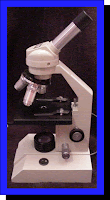
A microscope is a wonderful piece of technology, in that it allows us to look at our slide image wether its a red blood cell or the root of an onion in detail. "Micro" meaning small and "scope" meaning view. There are many different types of microscopes available, but the lab for this section was used with the Compound Light Microscope. Below is a quick description of the following pieces of the microscope: stage, focus knobs,iris,oculars, objectives.

Stage: The stage is where the slide is placed, with 2 clips to hold the slide into place. It moves up and down, but when the slide is in place ready to start viewing, make sure the stage is in highest position. Looking at the stage when moving it.


Focus knobs. The focus knobs are the coarse adjustment knob, which raises the image to a clear view when beginning the process. XY knobs move the slide up and down, left and right. The fine adjustment knob is used frequently, with slight turns, to get a clear/sharp view of the image. These knobs should be done while looking through the microscope.

Iris. The iris adjusts the light shining at the slide, while looking through the microscope. When changing objectives, its important to also adjust the iris.


Oculars. The oculars are located at the top of the microscope, also known as the eyepieces. These should be adjusted right away, an average distance is 64 for the right and left eyepiece, but should be adjusted to preference. Adjusting with both eyes open looking through the eye piece, 3/4 inches away.

Objectives. There are different objectives on the microscope, which basically are the magnification numbers. When starting to view a slide, the objective should be in 4x(shows the picture as a whole) and changed to higher magnification as preferred. When changing objectives, it's important to move the nose piece (where objectives are located) while looking at the microscope. Also when changing magnification to larger sizes: 10x, 40x ect. its important to readjust the iris.

Microscopes have come along way since it was first invented/used in 1595, by the Janssesn's. It basically consisted of a tube with a lens on each end of the tube. A couple other inventors that developed a more sophisticated microscope was: Hooke and Leeuwenhoek. Hooke is credited for discovering plant tissue under a microscope. Leeuwenhoek discovered bacteria in pond water and teeth. Other interesting individuals were the Egyptians, who used rock crystals shaped like lenses to view objects. The website shows many different and unique photos of microscopes used in previous years. With more experience and skills, microscopes developed into pieces of art.

Microscopes prove to be useful pieces of equipment, since a lot of these objects can not be seen without the use of magnification! Now with the technology of today's world, there are far more sophisticated microscopes available. Research is very popular in today's society, which would be difficult to study without the use of the 3-D microscopes(a few examples): the Dissection Microscope and the Scanning/Transmission Electron Microscopes.

Thursday, June 7, 2007

Unit One Com. Review

Compendium Review Unit I: Cells

Table of Contents

1. Basic unit of life: Cells

2. Molecules of Life
3. Plasma Membrane and it's Movement

4. Cell Structures

5. Tissues

BASIC UNIT OF LIFE- CELLS. "All living things, --- are made up of one or more cells (Ramel). I agree, it is quite amazing to think that each creature crawling around, plants sprouting for the season, birds flying through the sky, and our own beginning of life are all made up of cells!! In the first section of the text it describes the characteristics that all living things share. To begin; atoms bind together, forming molecules, which make up a cell. This organization is like a ladder, starting with: atom, molecule, cell, tissue, organ, organ system, organism, population, community, ecosystem, and biosphere. The environment is also a critical part of the ladder, being that we need the nourishment and energy it provides us with. Reproduction and Growth and development are ongoing until death. Homeostasis and Stimuli are both essential responses to our bodies. Evolution is a process that changes with time, but also helps trace back to our ancestry. There are two different types of cells. Prokaryotes (Bacteria) which do not have a nucleus, mitochondria, or any membrane bound organelle. They are single-celled and "as far as we know life began as a singe celled organism, which are essential to all life" (Ramel). The second group is Eukaryotes (Animals, Plants) which have a nucleus and organelles. They are multi-cellular and "arose much, much later in time, when the unicellular organisms learned they could be more successful working together" (Ramel).

MOLECULES OF LIFE. There are four main categories of organic molecules that are important to cells: Carbohydrates, Lipids, Proteins, and Nucleic Acid. I will briefly touch on each of these categories, which basically makes up the molecules of life. Think of CHO as fuel, it gives the cell the energy it needs to maintain its function. A couple examples are: glucose and starches. Lipids have the highest amount of energy, in that can not dissolve in water, and have a structured form (carbon and hydrogen). A few functions that are important are: "long-term energy storage, insulates against heat loss, and forms a protective cushion around major organs" (Mader 30). One of the most important functions of Protein is the role of enzymes, which regulates all of the cellular reactions (Carpi). I did not realize before that hair, hemoglobin and muscles are all part of protein. Nucleic Acids are divided into two types: DNA and RNA. DNA stores, replicates, and transmits genetic information. Which in turn is the role of RNA, it interprets the information from the DNA. The structure of the double- stranded DNA are: Thymine(T) - Adenine(A) and Guanine(G) - Cytosine(C). These bases form the hydrogen strung ladder. "ATP is the energy carrier within the cells" (Mader 36).

PLASMA MEMBRANE AND ITS MOVEMENT . The process a cell goes through to allow certain particles, substances, or molecules from entering or exiting its home is amazing. By surrounding this little cell, the plasma membrane helps keep the cell functioning. It is made of a phospholipid layer, which changes consistency with different temperatures. Since it is picky as to what enters or not, it is called selective permeable. Diffusion allows molecules to move, as they please, from high concentrations to low concentrations across the plasma membrane. Osmosis is diffusion of water across the plasma membrane. Facilitated Transport are helped across the membrane by protein carriers, which move with little bursts of energy. Active Transport is the process from low to high concentration, therefore, it needs energy to help it through. ATP, as mentioned in the previous paragraph, is used in this process. The energy is broken down to move across the membrane. Endocytosis is also known as phagocytosis, where a vesicle is pinched off and are engulfed. Exocytosis, the vesicles attach to the plasma membrane.
CELL STRUCTURES. The cell is formed by many different parts, which have important functions. The first part, which many of us are well acquainted with is the heart of the cell, the Nucleus. This structure is important for the cells DNA, or genetic information. Ribosomes are scattered in the cytoplasm, or attached to the endoplasmic reticulum. The main function for ribosomes is, protein synthesis. "The transcription phase (mRNA pairs up with an exposed DNA base) of protein synthesis, takes place in the cell nucleus" (Carpi). "The endomembrane system consists of : endoplasmic reticulum, the Golgi apparatus, lysosomes, and vesicles" (Mader 50). Cilia (short) and Flagella(long) are two types of sweeping movements within the cell. Mitochondria is another structure that aids in "converting the chemical energy of glucose products into the chemical energy of ATP molecules" (Mader 52). While researching an author stated the mitochondria is like a "power plant" pertaining to the energy it produces (Carpi). Within the cell, the chemical reactions such as, the jobs of enzymes and co-enzymes, are functioning parts for metabolism and cellular respiration (the breakdown of glucose to carbon dioxide and water). TISSUES. "A tissue is composed of specialized cells of the same type that perform a common function in the body" (Mader 62). There are four main tissues within our bodies: Connective, Muscular, Nervous, and Epithelial. When you bend your knee, you probably don't realize, but the Connective tissue is very structured by supporting and connecting tissues. It branches into 3 categories: Fibrous (adipose, tendons), Supportive (cartilage and bone) and Fluid(blood and lymph). Muscular Tissue help with movement. 3 types are: Skeletal(fast), Smooth and Cardiac(heart). Nervous Tissue supply nourishment to neurons. A neuron has 3 parts to it: a cell body, axon and dendrites(sensory strings attached to the body). Epithelial Tissue is like a blanket of protection. Types are: Simple(squamous, cuboidal, columnar) and Pseudostratified Columnar. All the systems in our body are important to maintain homeostasis. A few examples are Cardiovascular system( heart) Digestive System(liver) Respiratory System(lungs) Urinary(kidneys). Our bodies have many functions that continuously cycle on a daily basis.

Works Cited:
Carpi, Anthony. The Cell. Colorado University Denver. http://web.jjay.cuny.edu/~acarpi/NSC/13-cells.htm 7 june 2007.

-quotes, pictures
Mader, Sylvia S. Human Biology. Boston: McGrawHill Companies, Inc. 2008.
-quotes
Ramel, Gordon. Earthlife. http://www.earthlife.net/cells.html. 7 june 2007.
-quotes, pictures


Tuesday, June 5, 2007

Name: Amanda Barber
Section #: 10001
Favorite Artist: There are many creative/interesting people. Although my sisters are very artistic! Painting and drawing.
I'm taking BIO 156 as a pre req for the Nursing Program! I'm not sure what I'll achieve. I'm looking forward to learning about Human Biology life.
A few interesting things about my life: I have an amazing husband, who happens to be the love of my life(strange right?). We just had our one year anniversary at the end of May. Now we are looking forward to yet another new adventure in our lives, our first BABY in December!!

Sunday, June 3, 2007